

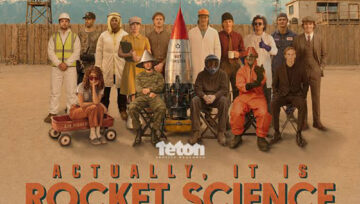
Actually, It Is Rocket Science Brings TGR Back to B.C. Powder
Actually, It Is Rocket Science brings Teton Gravity Research back to British Columbia powder for its 31st annual ski film, with Bute Inlet delivering one of the film’s standout locations and Canadian skiers Nick McNutt and Teal Harle in the mix.
The 2026 film travels through Bute Inlet, British Columbia; Haines, Alaska; Japan; Finland; Andorra; Montana; Jay Peak, Vermont; and Jackson Hole, Wyoming, following some of the world’s best skiers through wildly different terrain and snowpacks.
The “rocket science” theme is tongue-in-cheek, but the skiing is not. This is about speed, trajectory, airs, transitions, exposure, line choice and what happens when top-level skiers start pushing those variables in serious terrain.
Bute Inlet Delivers the B.C. Goods
For PowderCanada readers, Bute Inlet is the obvious draw.
The Coast Mountains around Bute are massive, remote and loaded with the kind of terrain that has kept British Columbia at the centre of big-mountain ski filmmaking for decades: long alpine faces, glaciers, steep walls, pillows, features and deep coastal snow.
When conditions line up, this is exactly the kind of terrain where strong skiers can open it up.
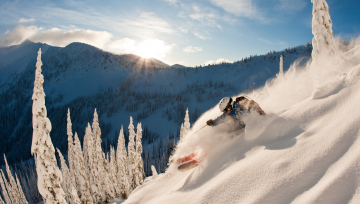
Bute is not resort skiing dressed up for the camera. It is proper Coast Mountain terrain, where scale matters and where the quality of the snow dictates how hard the athletes can push.
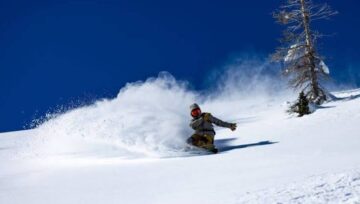
And when the snow is deep, the possibilities change fast.
Speed goes up, airs get bigger, transitions get softer and lines that would be marginal in firm conditions suddenly come alive.
That is the powder equation that matters.
Nick McNutt — Pure B.C. Freeride Style
Nick McNutt remains one of the most recognizable Canadian skiers in TGR’s modern film era.
McNutt grew up in Kimberley before moving to Whistler and building his skiing around the Coast Mountains, snowmobiles, pillows and deep snow.
His style has always been easy to spot.
McNutt skis natural terrain with a freestyle eye, blending big airs, spins, switch landings, pillows and fast technical lines without making it look forced.
That combination of creativity and big-mountain confidence is exactly why he works so well in B.C. terrain.
For Canadian skiers, McNutt also represents a very familiar path: grow up on a smaller B.C. hill, head west, chase snow, sled farther, ski bigger terrain and keep progressing.
Teal Harle Takes Freestyle Into the Backcountry
Teal Harle brings a different Canadian angle.
The Campbell River skier came through the elite slopestyle and big air world, representing Canada at the 2018 and 2022 Winter Olympics before moving deeper into filming and backcountry skiing.
That background shows.
Harle brings contest-level precision, amplitude and air awareness into natural terrain, but now the features are windlips, cliffs, pillows and alpine transitions instead of shaped jumps.
The interesting part is watching how quickly that skill set translates.
Backcountry terrain does not hand you a takeoff, landing or speed check. Harle has to build those calculations into the line itself, which makes his progression particularly well suited to the film’s “rocket science” premise.
Powder Around the World
The Canadian segments sit inside a much broader mix of snow and terrain.
The cast includes Nick McNutt, Teal Harle, Kai Jones, Karl Fostvedt, Parkin Costain, Maggie Voisin, Colter Hinchliffe, Kelly Hilleke, Keegan Kilbride and Tim Durtschi, along with other athletes appearing throughout the film.
Japan brings blower.
Alaska brings scale, spines and consequence.
Bute Inlet brings deep Coast Mountain snow and huge terrain.
Jay Peak brings eastern storm skiing, while Jackson Hole keeps the film connected to TGR’s home ground.
Different mountains, different snowpacks and different styles, but the same basic pursuit: find the line, trust the snow and ski it properly.
For PowderCanada, the Bute Inlet segment is the one that hits closest to home.
Big terrain, Canadian skiers and deep B.C. powder.
That is enough science for us.

Comments